The Roots Of An Equation
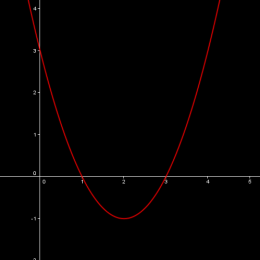
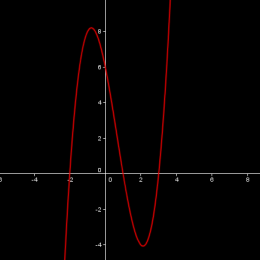
The roots of an equation are the values of $x$ at those points where the graph of the equation crosses the $x$-axis.
$ x=1\;\&\;x=3$
$ x=-2,\;x=1\;\&\;x=3$
Note that the above equation
can be factorised to:
$ y=(x-1)(x-3)$
Note that the above equation
can be factorised to:
$y=(x-1)(x+2)(x-3)$What is the connection between the roots of each equation and their factorised forms ?
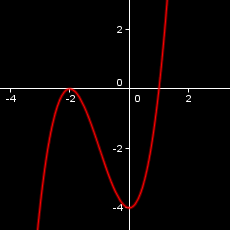
The graph of $y=x^3+3x^2-4$ (below) only crosses the x-axis twice.
This is because it has a repeated root.
$ x^3+3x^2-4\equiv(x-1)(x+2)(x+2)$