The three basic functions in trigonometry are Sine, Cosine & Tangent.
These are usually abbreviated to 'Sin', 'Cos' & 'Tan' .
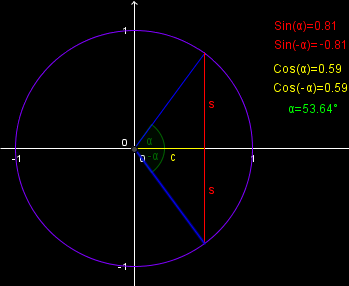
The applet to the right shows a point on a unit circle (radius=1).The angle $\alpha$ subtended at the origin by a radius to the point yields the values shown under the Sin and Cos functions.
If you drag the position of the point around the circle you will be able to see how the values change with $\alpha$.
Possibly the most commonly cited trigonometric identity is:
$ \fbox{$\sin ^2 \alpha + \cos ^2 \alpha = 1$}$
Note that $ \sin ^2 \alpha$ is the usual way of writing $ (\sin \;\alpha) ^2 $.
This can be simply derived from the diagram shown using Pythagoras' Theorem.
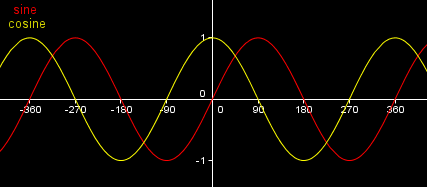
The graphs of the curves $ y=sin(x)$ and $ y=cos(x)$ are as follows
The function $tan(\alpha)$ is derived from $sin(\alpha)$ and $cos(\alpha)$ to give $ \fbox{$tan(\alpha)=\frac{\normalsize sin(\alpha)}{\normalsize cos(\alpha)}$}$
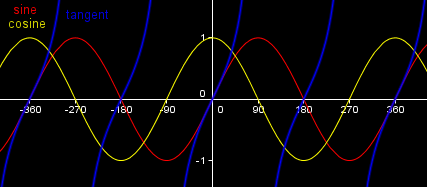
The graph of $tan(\alpha)$ is shown over $ sin(\alpha)$ and $cos(\alpha)$ below.
If you move the mouse over this diagram you will also be able to see a number of vertical lines called ' asymptotes '.
These occur when the value of $tan(x)$ is undefined.Try inputting
into a calculator.
Why does this happen ?The curve will become infinitely close to the asymptote, both above and below the $x$-axis, but will never touch it.
By careful examination of this diagram, other useful trigonometric identities can be discovered.
For example:
$ \boxed{sin(-\alpha)=-sin(\alpha)}$
and
$\boxed{cos(-\alpha)=cos(\alpha)}$
Can you find a similar identity for $ \small \tan(-\alpha)$ ?