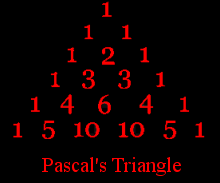
To the right is a diagram of part of Pascal's Triangle, where each number is found by adding together the two above it. These numbers can be used to find the terms in a binomial expansion.
Example 1:
It is a relatively simple task to multiply out $(x+y)^3$ , as follows:
$$\hspace{25px}\begin{align*}(x+y)^3 =&(x+y)(x^2+2xy+y^2)\\
=&x^3+3x^2y+3xy^2+y^3\end{align*}$$
It can be seen from this trivial example that the binomial coefficients match the fourth row in Pascal's triangle. (1,3,3,1)
Example 2:
To do the same with $(x+y)^5$ would be a very tedious process if it had to be done by hand, but using the relationship to Pascal's triangle this is much simplified.
Begin by determining the powers of $x$ and $y$.
$$\hspace{25px}\begin{aligned}(x+y)^5=\phantom{1} x^5 +\phantom{5}x^4y+\phantom{10}x^3y^2+\phantom{10}x^2y^3+\phantom{5}xy^4+\phantom{1}y^5\end{aligned}$$
... now insert the coefficients from the sixth line of the triangle.
$$\hspace{25px}\begin{aligned}(x+y)^5&=1 x^5 +5x^4y+10x^3y^2+10x^2y^3+5xy^4+1y^5\\ \\
&=\phantom{1} x^5 +5x^4y+10x^3y^2+10x^2y^3+5xy^4+\phantom{1}y^5\end{aligned}$$
Example 3:
It is important to remember that more complex binomials, with coefficients accompanying the terms, will need to be raised to the relevant power before determining the final coefficient.
To raise $(2x+3y)^3$ :
First determine the powers of $2x$ and $3y$ ...
$$\hspace{25px} (2x+3y)^3= \phantom{1\cdot}\,(2x)^3+\phantom{11}\,\,(2x)^2(3y)^1+\phantom{1}\;\;(2x)^1(3y)^2+\phantom{10}\,(3y)^3$$
... now insert the coefficients from the fourth line of the triangle ...
$$\hspace{25px} (2x+3y)^3
= 1\cdot(2x)^3+3\cdot(2x)^2(3y)^1+3\cdot(2x)^1(3y)^2+1\cdot(3y)^3 $$
... and finally, resolve the coefficients.
$$\hspace{25px}\begin{aligned} (2x+3y)^3=&\phantom{1()\cdot\,}8x^3+\phantom{(.)\cdot\cdot\cdot\cdot}\,36x^2y+\phantom{1.)\cdot\cdot\cdot\cdot}54xy^2+\phantom{1()}27y^3\end{aligned}$$
|