Differentiating a function, (or finding the derivative), yields a second function giving the rate of change of the initial function.
Stationary Points (maxima, minima & points of inflection)
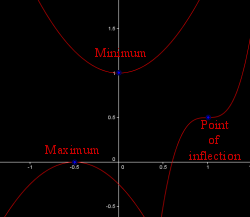
A stationary point is any point on a curve where the gradient is equal to 0.
The three types of stationary point are shown on the axes to the right.
Finding stationary points
To find the stationary points of the curve $y=x^3-2x^2-4x+1$ ,
the first step is to determine the gradient function.$$\hspace{75px}\frac{dy}{dx}=3x^2-4x-4$$
To identify where the above returns a gradient of 0, it should be factorised.
$$\hspace{75px}0=(3x+2)(x-2)$$
This gives the coordinates of the stationary points as:
$$\hspace{75px}\left(-\small\frac{2}{3}\normalsize,\large2\small\frac{13}{27}\normalsize \right)\hspace{30px}\&\hspace{30px}\large(2,-7 )$$
Classifying stationary points
There are a couple of methods for determining whether a stationary point is a maximum, a minimum or a point of inflection.
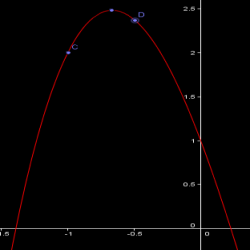
The first is by finding the coordinates either side of the point.
If the points with $x$ coordinates of -1 & $-\small\frac{1}{2}$ are tested by substitution into the original equation, their $y$ coordinates are both lower than that of the first stationary point. From this it may be deduced that the stationary point is a maximum.
Another, more elegant method, is to find what is termed the 'second derivative'.
This method works by finding the rate of change of the gradient at the given
stationary point.If we now differentiate the gradient function :
$$\hspace{75px}\begin{aligned}\frac{d}{dx}\left(\frac{dy}{dx}\right)&=\frac{d}{dx}(3x^2-4x-4)\\ \frac{d^2y}{dx^2}&=6x-4\end{aligned}$$
this equation tells us what is happening to the gradient as $x$ changes.
For the first stationary point, this returns
$$\hspace{75px} \begin{aligned}\frac{d^2y}{dx^2}&=6\left(-\small\frac{2}{3}\normalsize\right) - 4\\ &=- 8\end{aligned}$$
The important factor here is the sign of the result.
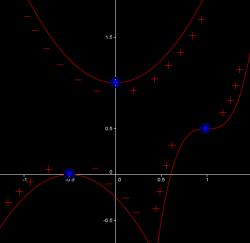
By examining what happens to the gradient at a stationary point (see right)
it is observed that at a maximum the gradient changes from +ve to -ve (becomes more -ve) , at a minimum it changes from -ve to +ve (becomes more +ve) and at a point of inflection its sign does not change (in this case it stays +ve).Since, from the result above, it can be seen that at the first stationary point the gradient is becoming more -ve, it follows that this point must be a maximum.
For the second stationary point, the point $(2,-7)$, the second derivative gives :
$$\hspace{75px}\begin{aligned}\frac{d^2y}{dx^2}&=6(2)-4\\ &=8\end{aligned}$$
Since the gradient at this point is becoming more +ve, this point must be a minimum.
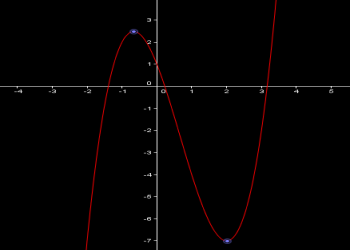
The graph of $y=x^3-2x^2-4x+1$ is given below, with the stationary points marked.
A Cautionary Note About Points Of Inflection
At a point of inflection, since the sign of the gradient is not changing, the second derivative will always return a value of 0.
A second derivative of 0 does not, however, mean that an inflection definately occurs at the given point.If the value of $\frac{d^2y}{dx^2}$ is 0 then the point must always be tested by finding values either side, as in the first method.
Throughout the examples above, Leibniz notation for derivatives has been used.
You may also be given the curve as a function of $x$ (Lagrange notation)
If presented this way, the derivatives should be notated as follows :