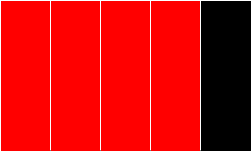
A fraction is used when a quantity or a whole is split into parts.
The Anatomy Of A Fraction
A simple fraction is made up of two parts:
the numerator - (the top number) $\hspace{113px}1$
& the denominator - (the bottom number). $\hspace{46px}\overline{\phantom{,}2\phantom{,}}$
When finding equivalent fractions, you must always do the same to the bottom of the fraction as you do to the top.
For example:
$\Large \frac{3}{4}\hspace{10px} =\hspace{10px} \frac{?}{8}$To turn the denominator (4) into the new one (8), it must be multiplied by 2.
$\Large \frac{3}{4}\hspace{10px}\underset{\normalsize \times 2}{=}\hspace{10px} \frac{?}{8}$Therefore the numerator (3) must also be multiplied by 2, giving:
$\Large \frac{3}{4}\hspace{10px}\underset{\normalsize{\times 2}}{\overset{\normalsize{\times 2}}=}\hspace{10px} \frac{6}{8}$$\therefore \hspace{50px}\Large \frac{3}{4} = \frac{6}{8}$
Similarly,
$\Large \frac{12}{15}\hspace{10px} =\hspace{10px} \frac{?}{5}$To turn the denominator (15) into the new one (5), it must be divided by 3.
$\Large \frac{12}{15}\hspace{10px}\underset{\normalsize{\div 3}}{=}\hspace{10px} \frac{?}{5}$Therefore the numerator (12) must also be divided by 3, giving:
$\Large \frac{12}{15}\hspace{10px}\underset{\normalsize{\div 3}}{\overset{\normalsize{\div 3}}=}\hspace{10px} \frac{4}{5}$$\therefore \hspace{50px}\Large \frac{12}{15} = \frac{4}{5}$
Important note:
When you are finding equivalent fractions you can only do it by multiplying or dividing the numerator and denominator.
It cannot be done by adding or taking away from both.
Unless told to do otherwise, fractions should always be left in their 'simplest form'.
The previous section explained how equivalent fractions could be found by either multiplying or dividing the numerator and denominator by the same number, and simplifying a fraction just means keep dividing the fraction until it is not possible to do so anymore.
Example 1:
Write the fraction $\Large \frac {12}{16}$ in its simplest form.
The largest number that exactly divides both 12 and 16 is 4 (the highest common factor), so divide the numerator and the denominator by 4.
$\Large \frac{12}{16} \underset{\normalsize{\div 4}}{\overset{\normalsize{\div 4}}=}\frac{3}{4}$
$\therefore \hspace{50px} \Large \frac{12}{16}$ in its simplest form is $\Large \frac{3}{4}$
Example 2:
Given a fraction with larger numbers, it may not always be possible to find the h.c.f. of the numerator and denominator, in which case you should keep dividing by any factors that you can find until it is no longer possible.
$\Large \frac{42}{48} \underset{\normalsize{\div 2}}{\overset{\normalsize{\div 2}}=}\frac{21}{24}\underset{\normalsize{\div 3}}{\overset{\normalsize{\div 3}}=}\frac{7}{8}$
$\therefore \hspace{50px}\Large \frac{42}{48}$ in its simplest form is $\Large \frac{7}{8}$
It is important to be able to change fractions between mixed numbers and what are called 'improper' or 'top-heavy' fractions.
A mixed number also includes a whole number part:
$$ \hspace{50px}e.g.\hspace{20px} 4\frac{1}{2}$$
=
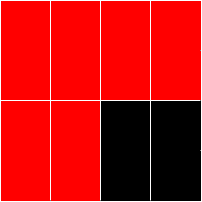
=
Mixed numbers $\rightarrow$ Improper fractions
$\Large 2\frac{3}{5}$ can be turned into an improper fraction as
shown below.Each whole is made up of 5 fifths.
Therefore, 2 wholes are made up of 10 fifths.
This is then added to the other 3 fifths, giving 13 fifths.
$\therefore \hspace{50px}\Large 2\frac{3}{5}=\frac{13}{5}$A shortcut to this method is shown below:
$\Large 2\frac{3}{5}=\frac{2\times5+3}{5}=\frac{13}{5}$
(note that the denominator stays the same)
Improper fractions $\rightarrow$ Mixed numbers
The improper fraction $\Large \frac{14}{3}$ can be changed into a mixed number as shown below.
It takes 3 thirds to make 1 whole.
Therefore 4 wholes can be made, (using 12 of the thirds), with 2 of the thirds left over.
$\therefore \hspace{50px} \Large \frac{14}{3}=4\frac{2}{3}$Using the fact that the line across the middle of a fraction means 'divide', a shortcut to this is:
$\large \frac{14}{3}=14\div 3=4\hspace{5px} r \hspace{5px}2 = 4\frac{2}{3}$
(note that the denominator stays the same)
In order to add or subtract fractions, they first have to have the same denominator.
This is acheived by converting them to equivalent fractions.Example 1:
To find $\Large \frac{1}{2}+\frac{1}{3}$
2 & 3 both divide into 6, so:
$\hspace{180px}\Large \frac{1}{2}=\frac{?}{6}\hspace{20px}\overset{\normalsize{\times 3}}{\underset{\normalsize{\times 3}}=}\hspace{20px}\frac{3}{6}$
and
$\hspace{180px}\Large \frac{1}{3}=\frac{?}{6}\hspace{20px}\overset{\normalsize{\times 2}}{\underset{\normalsize{\times 2}}=}\hspace{20px}\frac{2}{6}$Now they can be simply added together.
$\hspace{50px}\Large \frac{3}{6}+\frac{2}{6}=\frac{5}{6}$
(note that the denominator stays the same)Example 2:
To find $\Large \frac{3}{4}-\frac{2}{5}$
4 & 5 both divide into 20, so:
$\hspace{180px}\Large \frac{3}{4}=\frac{?}{20}\hspace{20px}\overset{\normalsize{\times 5}}{\underset{\normalsize{\times 5}}=}\hspace{20px}\frac{15}{20}$
and
$\hspace{180px}\Large \frac{2}{5}=\frac{?}{20}\hspace{20px}\overset{\normalsize{\times 4}}{\underset{\normalsize{\times 4}}=}\hspace{20px}\frac{8}{20}$Now simply subtract..
$\hspace{50px}\Large \frac{15}{20}-\frac{8}{20}=\frac{7}{20}$
(note that the denominator stays the same)Example 3:(with mixed numbers)
To find $\large 3\frac{1}{4}+2\frac{1}{3}$
First turn the mixed numbers into improper fractions:
$\large 3\frac{1}{4}=\frac{3\times 4+1}{4}=\frac{13}{4} \hspace{30px}\normalsize{\&}\large \hspace{30px} 2\frac{1}{3}=\frac{2\times 3+1}{3}=\frac{7}{3}$
Now proceed as above to add $\Large \frac{13}{4}+\frac{7}{3}$
4 & 3 both divide into 12, so:
$\hspace{180px}\Large \frac{13}{4}=\frac{?}{12}\hspace{20px}\overset{\normalsize{\times 3}}{\underset{\normalsize{\times 3}}=}\hspace{20px}\frac{39}{12}$
and
$\hspace{190px}\Large \frac{7}{3}=\frac{?}{12}\hspace{20px}\overset{\normalsize{\times 4}}{\underset{\normalsize{\times 4}}=}\hspace{20px}\frac{28}{12}$Now they can be simply added together.
$\hspace{50px}\Large \frac{39}{12}+\frac{28}{12}=\frac{67}{12}$This answer is an improper fraction, so it should be changed back into a mixed number.
$\therefore \hspace{70px} \large \frac{67}{12}=67\div 12 = 5 \hspace{5px} r \hspace{5px}7 = 5\frac{7}{12}$Unusually, multiplying fractions is the easiest operation to perform, and is best explained by example.
Example 1:
$\Large \frac{1}{2}\times \frac{3}{4} = \frac{1\times3}{2\times4}=\frac{3}{8}$
Example 2:
$\Large \frac{4}{7}\times \frac{3}{8}=\frac{4\times3}{7\times8}=\frac{12}{56}$
This answer should now be simplified :
$\Large \frac{12}{56} \underset{\normalsize{\div4}}{\overset{\normalsize{\div4}}=}\frac{3}{14}$$\therefore \hspace{50px}\Large \frac{4}{7}\times \frac{3}{8}=\frac{3}{14}$
Example 3:(with mixed numbers)
$\large 3\frac{1}{4}\times2\frac{1}{3}=\Large\frac{13}{4}\times\frac{7}{3}=\frac{13\times7}{4\times3}=\frac{91}{12}=7\frac{7}{12}$
The method for division of fractions is very similar to that for multiplication. The only difference is that the second fraction is turned upside-down, as shown below.
Example 1:
$ \begin{aligned} \frac{1}{2}\div \frac{3}{4}&= \frac{1}{2}\times\frac{4}{3}=\frac{1\times4}{2\times3}\\&=\frac{4}{6}\\&=\frac{2}{3}
\end{aligned}$
Example 2:(with mixed numbers)
$\begin{aligned} 3\frac{1}{4}\div2\frac{1}{3}&=\frac{13}{4}\div\frac{7}{3}=\frac{13}{4}\times\frac{3}{7}\\
& =\frac{13\times3}{4\times7}=\frac{39}{28}\\&=\large 1\frac{11}{28}
\end{aligned} $