Two or more equations are simultaneous if they have a point of intersection.
i.e. they have points with coincident values of x and y.
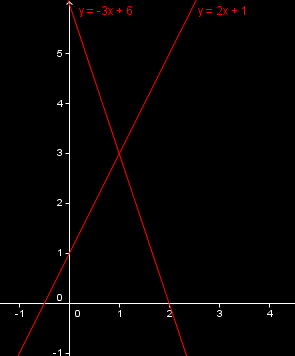
In the example to the right, the lines $ y=2x+1\;\; \scriptsize\&\;\; \normalsize y=-3x+6$
are both shown.It can easily be seen from this diagram that the intersection is at the point (1,3).
This graphical method works well when the intersection yields integral results but, in order to solve more complex examples it is important to understand the more commonly used algebraic methods.Method 1 (column subtraction / addition)
To eliminate $y$:
$y=-3x+6\\ y=\;\;\,2x+1 \;\;\;\;-\\ \overline{0=-5x+5} $
Solving this for $x$ gives:
$ x=1$
Substituting this value into either equation gives the point of intersection of the two lines as $(1,3)$ .
Sometimes simultaneous equations are given in a more complex form which could lead to fractional coefficients if rearranged into the form '$y = . . .$'
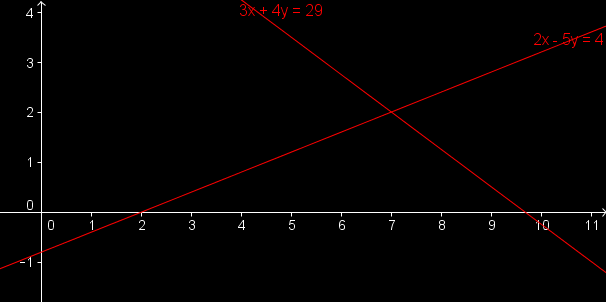
Take the example opposite,
$2x-5y=4 \;\; \scriptsize \&\;\; \normalsize 3x+4y=29$
In order to have coefficients which may be cancelled, one or both should be multiplied by an appropriate amount.
$2x-5y=4 \;\;\;\;\overset {\times 3}{\longrightarrow} \;\;\ 6x-15y=12\\ 3x+4y=29 \,\;\;\!\underset {\times 2}{\longrightarrow} \;\;\ \underline{6x+\;\;8y=58}\hspace{20px} -\\\\ \hspace{215px} -23y=-46 $
to give a $y$ value of 2 which can then be substituted to give the $x$ value of 7.
Again using the first example of:
$y=2x+1\;\; \scriptsize\&\;\; \normalsize y=-3x+6$
Since at the point of intersection the values of $y$ and $x$ will be identical, it must be true that :
$ \begin{array}{rcl} 2x+1 &=& -3x+6\\ 2x+3x &=& 6-1\\ 5x &=& 5\\ x &=& 1\\ \end{array} $
at the point of intersection.
This will, again by substitution, give the correct point of intersection.
Intersection of a Quadratic and a Linear Equation
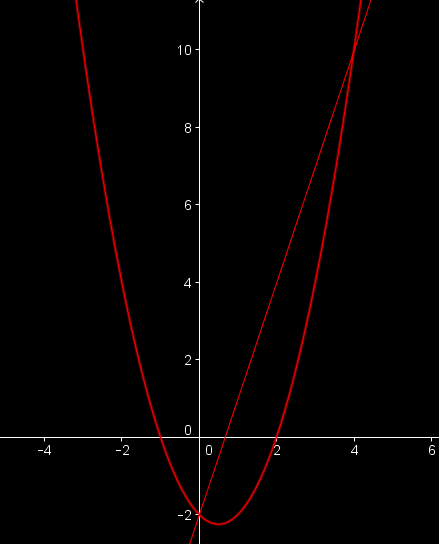
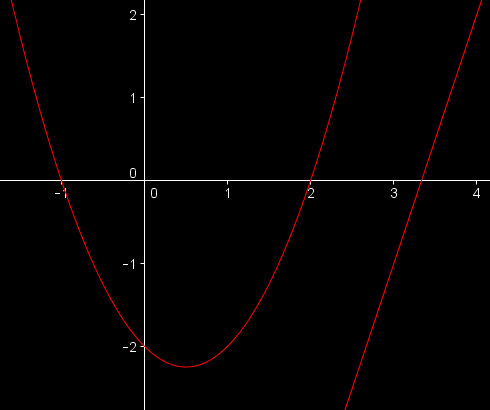
In this example the graph depicts
$y=x^2-x-2 \;\; \scriptsize\&\;\; \normalsize y=3x-2$
Using Method 2 above, it is true that:
$x^2-x-2 \;\;=\;\; 3x-2$
at the points of intersection. (see note below)
This may then be rearranged to give :
$x^2-4x =0$ which can then be solved for $x$ by factorisation.
Factorising will give roots of 0 and 4.
Substituting these values for x into either equation will give points of intersection at :
$ \hspace{100px}(0,-2) \;\; \small\&\;\; \normalsize (4,10)$
Important note about number of intersections
Usually a quadratic and a straight line will inersect in two places.
This is, however, not always the case.
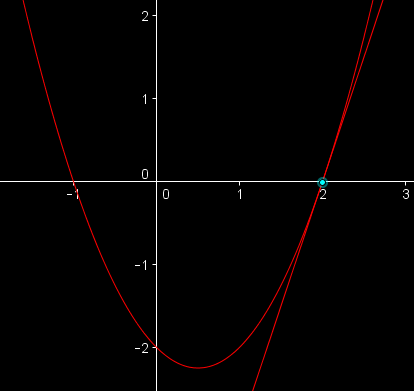
If the line is a tangent to the curve then there will only be one intersection. (repeated root of quadratic)
The example to the right shows the graph of
$y=x^2-x-2 \;\; \scriptsize\&\;\; \normalsize y=3x-6$
Using the above method gives the quadratic
$(x-2)^2=0$ which has only a single, repeated root.
It is, of course, possible that they never meet. (no roots)
The next diagram shows$ y=x^2-x-2 \;\; \scriptsize\&\;\; \normalsize y=3x-10$>
These can be combined to give :
$ x^2-4x+8=0 $ which has no real roots.
Try putting the appropriate coefficients into the quadratic formula and see what happens.
Intersection Of A Line And A Conic Section (including circles)
If it is required to find where a straight line intersects with a circle or other type of conic section, a different method needs to be employed.
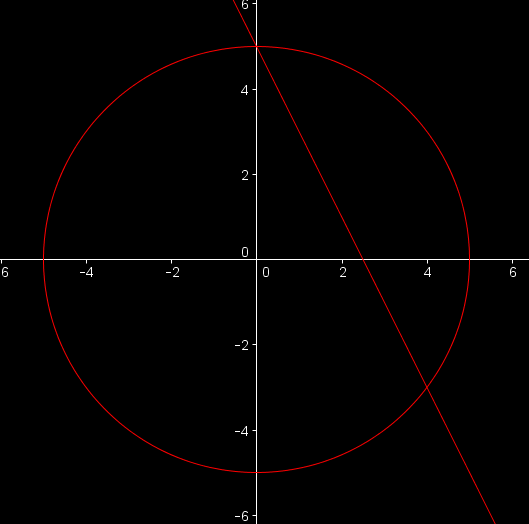
Take as an example :$ x^2+y^2=25 \;\; \scriptsize\&\;\; \normalsize y=-2x+5$
In this instance it is possible to substitute the equation of the line into the equation of the circle as follows :
$ \begin{array}{rcl} x^2+(-2x+5)^2 &=&25\\ x^2+(4x^2-20x+25)&=&25\\ 5x^2-20x+25&=&25\\ 5x^2-20x&=&0\\ 5x(x-4)&=&0\\ \end{array} $
The intersections therefore occur when $x=0$ and $x=4$. Substituting these into the simpler equation gives intersections at :
$(0,5) \;\; \small\&\;\; \normalsize (4,-3) $