The methods employed for solving trigonometric equations are identical to those used for regular algebraic equations,
however it must be remembered that there is often more than one possible answer.
In the section on basic trigonometry the following identities were found:
$\small{\sin^2(\alpha)+\cos^2(\alpha)=1} \small $ , $ \small{ \tan(\alpha)=\frac{\small \sin(\alpha)}{\small cos(\alpha)}} $
$$\small {\sin(-\alpha)=-\sin(\alpha)} \hspace{20px}, \hspace{20px} \small{\cos(-\alpha)=\cos(\alpha)} \small \hspace{20px}, \hspace{20px} \small {\tan(-\alpha)=-\tan(\alpha)}\\ $$
There are, however, others, some of which will be used here.
Find all the values of $ \small \alpha $ when $\small 0^\circ \leq \alpha \leq 360^\circ$ , such that $ \small sin(\alpha)=0.25$ . Give your answer to 2 d.p.
Using the $ \small sin^{-1}$ button on the calculator should give the result 14.48 °
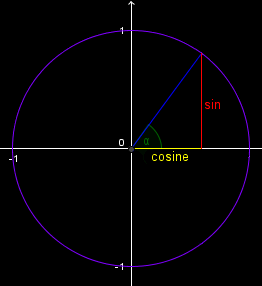
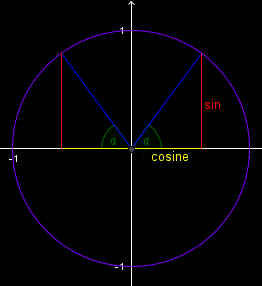
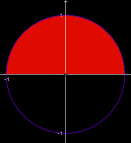
By examining the circle diagram, it should be clear that another possible answer in the given range
is given by 180° - 14.48°This gives the two answers of : $\small \alpha $=14.48° & $ \small \alpha $=165.52°
From this we can state that :
$ \boxed {\sin(\alpha)=\sin(180^{\circ} -\alpha)}$
Find all the values of $\small \alpha $ when $\small 0^\circ \leq \alpha \leq 360^\circ$ , such that $ \small cos(\alpha)=-0.866$ . Give your answer to 2 d.p.
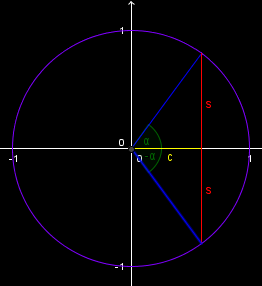
Using the identity $ cos(-\alpha)=cos(\alpha)$ , and the $\small cos^{\tiny-1}$ button on the calculator gives
$\small \alpha $=150° and $ \small \alpha $= -150°The second answer, however, is not within the required range. But -150° is the same as 210°, so the final answer is :
$ \small \alpha $=150.00° & $ \small \alpha $=210.00°
From this we can state that :
$ \boxed {\cos(\alpha)=\cos(360^{\circ} -\alpha)}$
Example 1c:
Find all the values of $ \small \alpha $ when $ \small 0^\circ \leq \alpha \leq 360^\circ $ , such that $ \small \tan(\alpha)=2.5$ . Give your answer to 2 d.p.
Using the $ \small \tan^{\tiny-1}$ button on the calculator, gives $ \small \alpha $=68.20° .
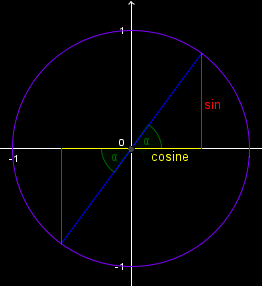
Since the tan function is obtained by dividing the sine by the cosine, in order to keep the result the same the signs of both sin and cos must be inverted.
This is acheived by projecting the radius through the origin, thus adding 180° to the value of $\small \alpha $.
This, therefore, gives us a second result of 180° + 68.20°
The final result is $ \small \alpha $=68.20° & $ \small \alpha $=248.20°
From the above can also be derived the identity:
$ \boxed{\tan(\alpha)=\tan(180^{\circ}+\alpha)}$
Answering this type of question which asks for an 'exact ' solution, requires use of Pythagoras' theorem and SOHCAHTOA.
Example 2:
Find the exact values of $ \small \tan(\alpha) $ when $ \small 90^\circ \leq \alpha \leq 360^\circ $ , such that $ \small sin(\alpha)=\frac{1}{2} $ .
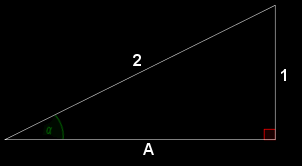
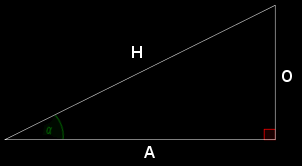
Using $ \small sin(\alpha)=\frac{\small O}{\small H} $ the following triangle may be constructed :
Using Pythagoras' theorem , the adjacent side must have a length of $ \small \sqrt {3} $ .
Now that all three sides of the triangle are known, SOHCAHTOA may be used to find the value of $ \small \tan(\alpha) $
Caution:
Angles obtained from SOHCAHTOA only apply to the first quadrant .From the initial question, the value of $ \small sin(\alpha) $ is positive, so the angle must be in one of the two upper quadrants.
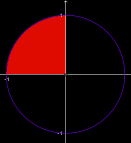
Therefore, by SOHCAHTOA, $ \small \tan(\alpha)=\pm \hspace{3}\frac{1}{\sqrt{3}} $The question also states that $ \small 90^\circ \leq \alpha \leq 360^\circ $ , so the angle required must be in the top-left quadrant.
Here the value of the tan function is always negative, since $ \small sin(\alpha) $ is positive and $ \small \cos(\alpha) $ is negative.
This gives a value for $ \small \tan(\alpha) $ of $ \small - \frac{1}{\sqrt{3}} $ .
$\small sin(\alpha)=\frac{\small O}{\small H}\;\;\;\;\;\; cos(\alpha)=\frac{\small A}{\small H} \\ \;\;\;\;\;\;\;\;\;\;\;t\small an(\alpha)=\frac{\small O}{\small A}$
Sometimes a question will ask you to find an angle when a multiple of it appears within the trigonometric function, e.g. $ \small \sin(2\alpha)=0.5 $
Example 3a:
Find all the values of $ \small \alpha $ when $ \small 0^\circ \leq \alpha \lt 360^\circ $ , such that $ \small \sin(2\alpha)=0.5 $ .
To begin with, this can be solved as usual on the calculator.
This gives a principal value of $ \small 2\alpha = 30^\circ $ .
Using the identity from example 1a, $ \small {sin(2\alpha)=sin(180^{\circ} -2\alpha)}$
Therefore the secondary value of $ \small 2\alpha$ is $ \small 150^\circ $
Since the above are values for $ \small 2\alpha$, they will both have to be halved to find the final answers.
Since $ \small \alpha $ must be in the range $ \small 0^\circ \leq \alpha \lt 360^\circ $, it follows that $ \small 2\alpha $ can be in the range $ \small 0^\circ \leq 2\alpha \lt 720^\circ $ .
The third (tertiary) and fourth (quaternary) results can be found by adding $ \small 360^\circ $ to our principal and secondary results, as this would bring a point on the unit circle back to the same position.
This gives four values for $ \small \, 2\alpha \;$ of $ \small \;30^\circ ,\; 150^\circ ,\; 390^\circ \; \tiny \& \;\small 510^\circ$ .
Halving all of these gives a final answer of:
$ \boxed{ \small \alpha=15^\circ \;,\;75^\circ\;,\;195^\circ \;,\;255^\circ}$
Example 3b:
Find all the values of $ \small \alpha $ when $ \small 0^\circ \leq \alpha \lt 360^\circ $ , such that $ \small \cos\left(\frac{\alpha}{2}\right)=-0.5 $ .
Using the calculator, the principal value is: $ \small \frac{\alpha}{2}=120^\circ $
Using the identity from example 1b, $ \small {\cos\left(\frac{\alpha}{2}\right)=\cos\left(360^{\circ} -\frac{\alpha}{2}\right)}$
Therefore the secondary value of $ \small \,\frac{\alpha}{2}$ is $ \small 240^\circ $ .
Since the above are values for $ \small \,\frac{\alpha}{2}\,$, they will both have to be doubled to find the final answers.
As$ \small \,\alpha $ must be in the range $ \small 0^\circ \leq \alpha \lt 360^\circ $, it follows that $ \small \,\frac{\alpha}{2}\, $ must be in the range $ \small \,0^\circ \leq \,\frac{\alpha}{2} \,\lt 180^\circ $ .
As a result, the secondary value is not valid, since doubling it would give $ \small \,\alpha = 480^\circ $
Doubling the principal value gives a final answer of:
$ \boxed { \small \alpha=240^\circ }$
$ \small \sin(2\alpha)= \sin(2\alpha + 360^\circ)$
A similar approach to that in the two examples above can be taken for functions involving tan .
It can be seen that when the trigonometric function operates on $ \small 2\alpha $ , there are twice as many potential results as when just on $ \small \,\alpha $.
Also, when the function operates on $ \small \,\frac{\alpha}{2}\, $ , there are half as many results.What would happen if $ \small \,3\alpha $ or $ \small \,\frac{\alpha}{4}\, $ were used ?
How does this depend on the results found ?